

Bandung, 13 February 2026 - The Directorate of Research and Development of ZIS-DSKL at BAZNAS RI conducted an official visit on Thursday, 12-13 February 2026, to present the results of the 2025 National Zakat Index (IZN) and Zakat Impact Assessment (KDZ) for West Java Province.
The visit was led by the Director of Research and Development of ZIS-DSKL, Muhammad Hasbi Zaenal, Ph.D, and was attended by the research team Tri Alfiani, MIFP, as well as Nur Rochmawati, M.Pd, representing the Secretariat of the Ministry of Religious Affairs of the Republic of Indonesia. The primary objective of this engagement was not only to disseminate the results of the IZN and KDZ calculation but also to discuss their policy implications for strengthening zakat governance and enhancing its socio-economic impact in West Java.
Notably, the participation rate of all BAZNAS institutions across West Java in completing the 2025 IZN assessment reached 100 percent. This achievement demonstrates a strong institutional commitment to performance-based zakat governance. Furthermore, the aggregate IZN score of West Java Province shows a positive growth trend compared to the baseline and moves closer to the target set in the Regional Medium-Term Development Plan (RPJMD). Therefore, the findings reaffirm the strategic role of zakat as a measurable and accountable instrument for regional development.
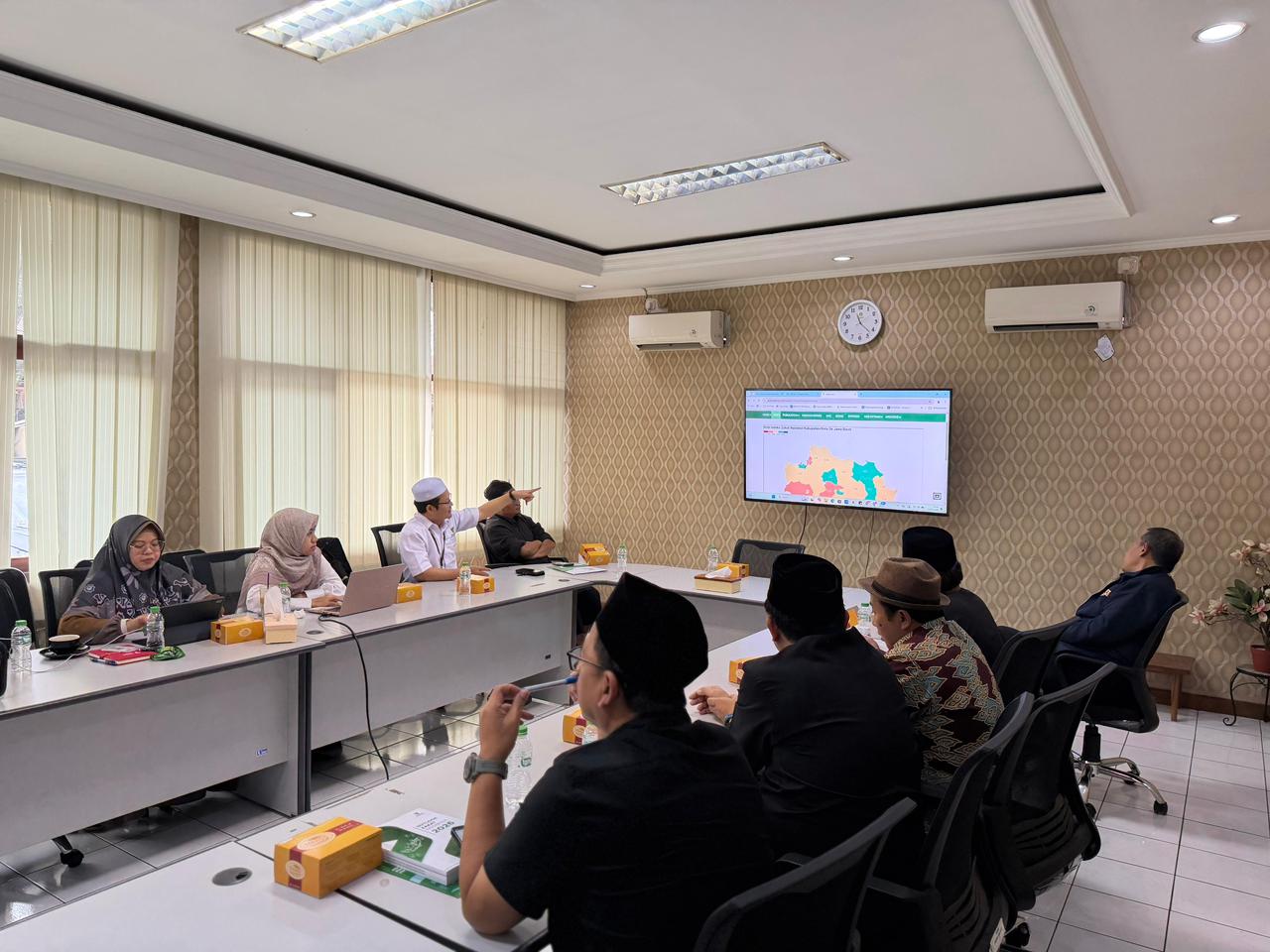
In his presentation, Dr. Hasbi emphasized that the implementation of IZN version 3.0 goes beyond administrative assessment, as it integrates macro and micro dimensions of zakat performance. Specifically, the impact evaluation incorporates several quantitative approaches, including the Poverty Indicators framework, the CIBEST Model, the Modified Zakat Utilization Index (IPZ), and the Time Taken to Exit Poverty measurement. Consequently, zakat performance is assessed not only in terms of governance quality but also in relation to poverty alleviation, productive transformation, and sustainable welfare improvement among beneficiaries (mustahik).
Moreover, on Friday, 13 February 2026, the delegation continued its agenda by conducting a benchmarking visit to the Journal Management Center of UIN Sunan Gunung Djati Bandung. This visit was intended to strengthen journal governance and enhance publication management practices, particularly in areas such as accreditation standards, indexing strategies, editorial management systems, and internationalization efforts.
Through these consecutive activities, the Directorate of Research and Development of ZIS-DSKL reaffirmed its commitment to advancing evidence-based zakat policy and improving the quality of academic publications in the field of Islamic social finance. Ultimately, these initiatives reflect the broader institutional mission of BAZNAS RI to promote accountable, professional, and impact-oriented zakat management at both regional and national levels.