
JAKARTA, INDONESIA — The National Amil Zakat Board of Indonesia (BAZNAS) has officially commenced the 2026 National Zakat Index (IZN) and Zakat Impact Study (KDZ), marking a major shift from traditional, consumptive charity toward structured, data-driven productive empowerment programs across the nation.
The launching event, held during a virtual kickoff meeting, gathered key leaders from the Ministry of Religious Affairs, the Ministry of National Development Planning (Bappenas), and the National Sharia Economy and Finance Committee (KNEKS), alongside regional governments and amil zakat institutions from all provinces and regencies.

A Transformative Paradigm Shift
During the launch, BAZNAS leaders emphasized that the 2026 assessment represents a pivotal step in continuous improvement for zakat management. The focus is transitioning from output-based metrics—such as the total amount of funds collected—to measuring actual outcomes and long-term socio-economic impact.
“Our success is no longer judged solely by how much we collect, but by how many lives we successfully transform for the better,” said H. Syarifuddin, S.Ag., M.E., the BAZNAS Commissioner for Research, Development, Planning, and Innovation. He highlighted that zakat interventions must move away from short-term charity to sustainable empowerment models tailored to local characteristics.
This paradigm shift is already showing massive national results. Throughout 2025, national zakat programs successfully helped lift more than 300,000 individuals out of poverty across Indonesia, with over 113,000 of them rescued from the bracket of extreme poverty.
Strategic Integration and Rising National Index
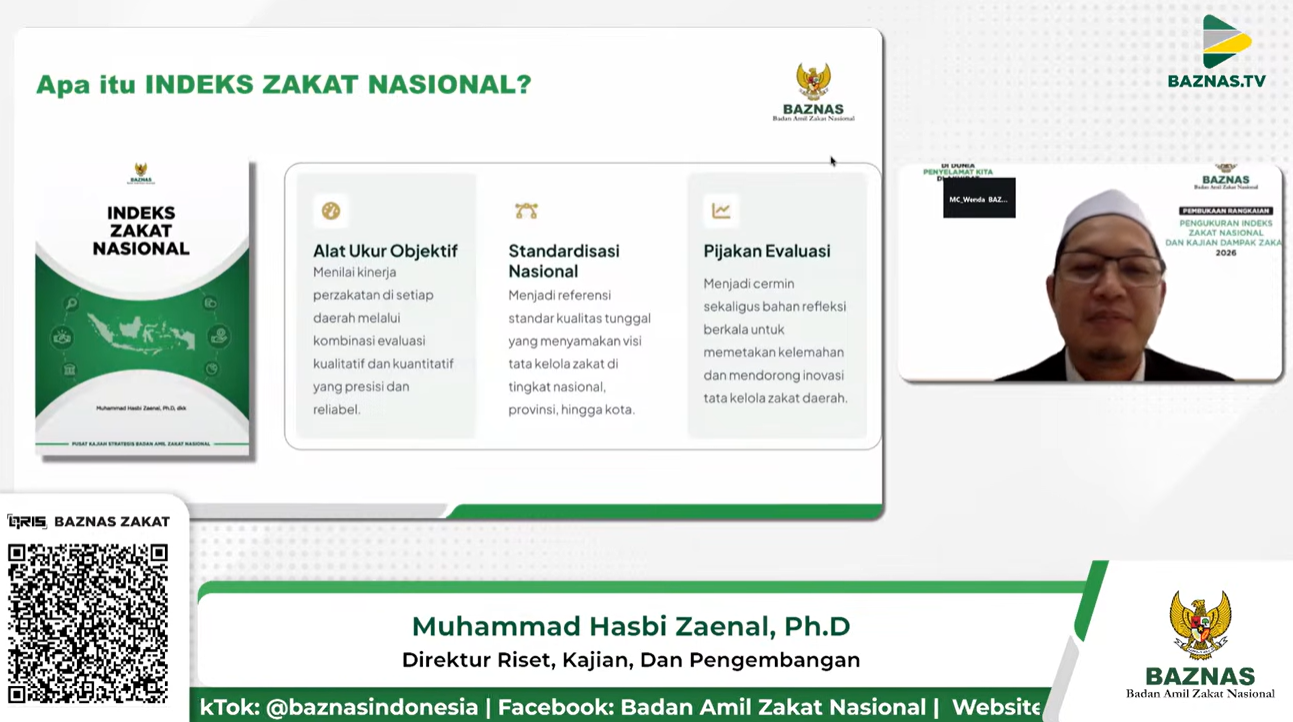
The National Zakat Index has shown a steady upward trajectory in recent years, climbing from 0.47 to 0.52, and reaching 0.57 in 2025, which places the nation's zakat management in the “stable” category. BAZNAS has set a long-term target to increase this national average score to 0.65 by 2031.
In a major institutional milestone, the index has transitioned from being an internal BAZNAS tool to a recognized metric for regional development planning. Currently, 21 provinces and 181 regencies and cities have integrated the index into their Regional Medium-Term Development Plans (RPJMD) through the Regional Government Information System (SIPD).
Dr. Ir. H. Sodik Mujahid, M.Sc., Chairman of BAZNAS RI, underscored that these measurements serve dual purposes. "At the micro-level, we mobilize funds to meet the immediate needs of the underserved and alleviate poverty. At the macro-level, we are strengthening the Sharia economic ecosystem—driving the halal industry, financial inclusion, and Sharia literacy."
Enhancing Accuracy Through Random Sampling
To further refine the quality of data, BAZNAS is introducing the IZN 3.0 framework along with an updated random sampling methodology for the 2026 Zakat Impact Study.
According to BAZNAS researchers, local zakat institutions will submit their full 2025 mustahik populations by September 15, which BAZNAS will then process using statistical clustering and random selection to designate targeted survey respondents. This approach ensures that the impact of zakat is assessed with absolute rigor, looking beyond income generation to encompass spiritual growth, education, health, and overall family welfare using the CIBEST model.
Timeline and Collaboration
All amil zakat institutions and local BAZNAS chapters across Indonesia are required to complete and submit their assessments through the integrated SIGMA information system by November 30.
To support local amil staff throughout the process, BAZNAS will hold intensive weekly technical clinics every Wednesday morning, ensuring robust data collection and fostering stronger collaboration between amil institutions and local governments.
For more information and to access the official IZN dashboard, organizations can visit the integrated BAZNAS platform.